Measure the Diameter of a Small Sphere or Cylinder Using Vernier Calipers
- December 28, 2019
🎯 Aim
To measure the diameter of a small spherical or cylindrical body using vernier calipers.
🧰 Apparatus Required
- Vernier calipers
- Small spherical or cylindrical object (e.g., metal bob)
📘 Theory
Vernier calipers have the following key parts:
- Main Scale
- Vernier Scale
- Movable Jaws
- Metallic Strips / Depth Rod
Vernier Readings
If a body is held between the jaws:
- Let the zero of the vernier scale lie just ahead of the Nth division of the main scale.
The main scale reading (M.S.R.) = N (in cm).
If the nᵗʰ division of the vernier scale coincides with any division of the main scale, then the vernier scale reading (V.S.R.) is:
V.S.R. = n × V.C. (cm)
where the vernier constant (V.C.) is given by:
V.C. = 1 M.S.D. – 1 V.S.D.
Therefore, the total reading (T.R.) is:
T.R. = M.S.R. + V.S.R.
T.R. = N + (n × V.C.) cm
🧭 Procedure
✔️ Preliminary Steps
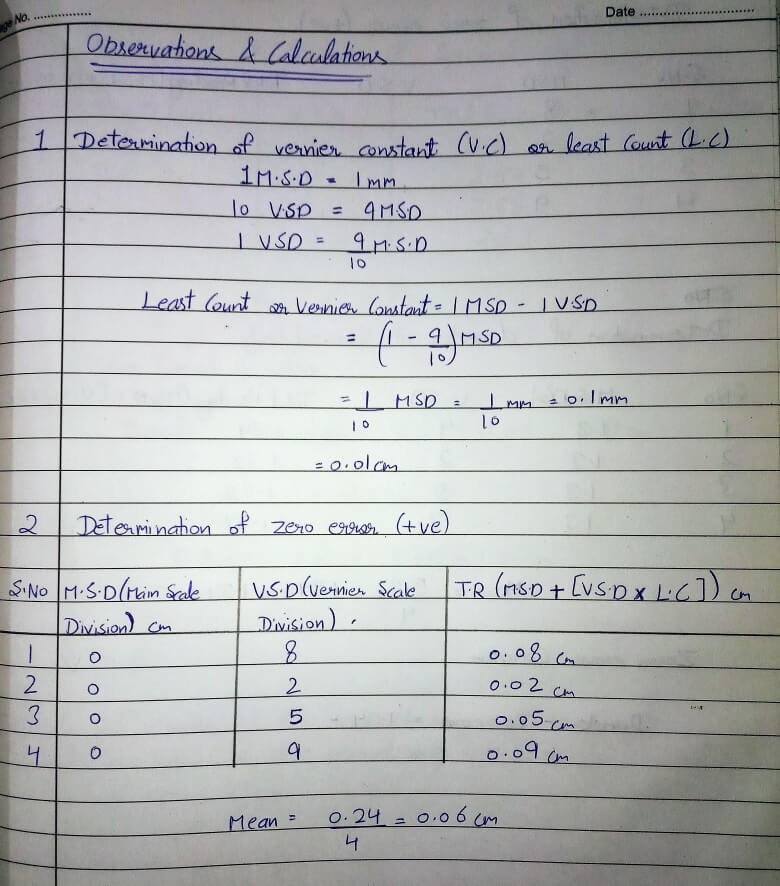
(i) Read the main scale and determine 1 Main Scale Division (MSD).
(ii) Calculate the Vernier Constant (V.C.) using:
[
\text{V.C.} = 1,\text{MSD} - 1,\text{VSD}
]
Find and record the zero error (positive or negative).
✔️ Measurement Steps
(iii) Place the object gently between jaws A and B, without applying excess pressure.
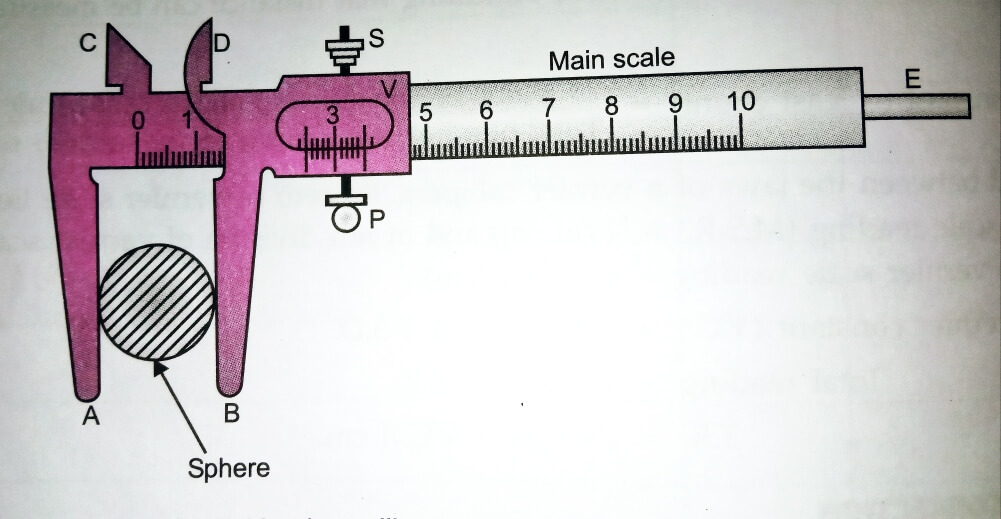
(iv) Note the main scale reading N just to the left of the vernier zero.
(v) Note the vernier division n that exactly coincides with any main scale line.
Then compute:
[
\text{T.R.} = N + (n \times \text{V.C.})
]
(vi) Rotate the object 90°, and again record ( N’ ), ( n’ ), and total reading:
[
\text{T.R.}’ = N’ + (n’ \times \text{V.C.})
]
(This completes one set.)
(vii) Repeat readings at two more positions on the object.
(viii) Calculate the mean corrected diameter.
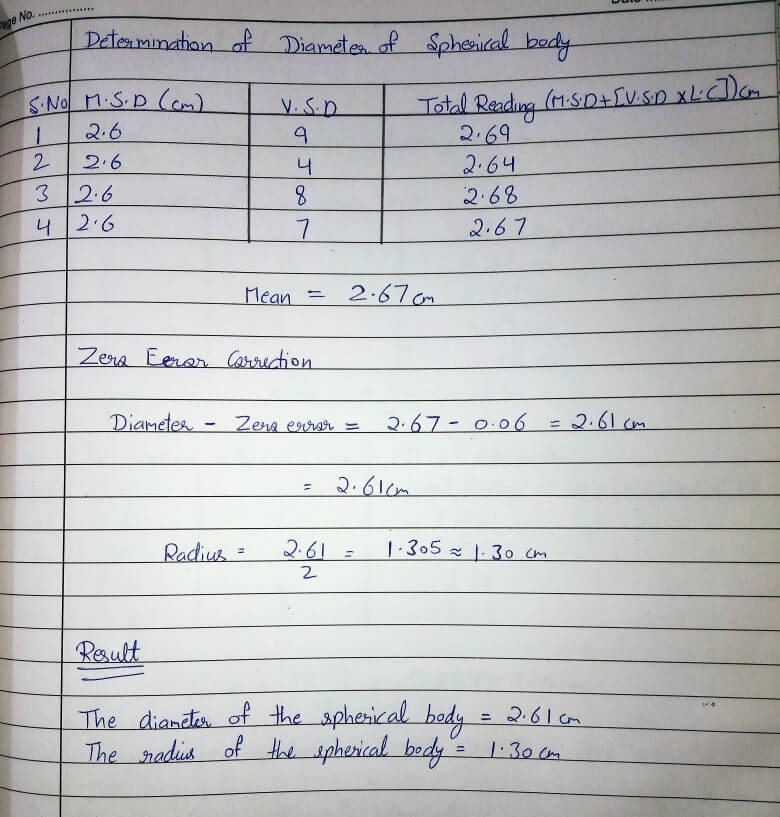
📊 Observations
✔️ Precautions
- Ensure smooth movement of the vernier; clean or oil if required.
- Hold the body firmly but without excessive force.
- Carefully compute V.C. and zero error.
- Take readings at right angles for accuracy.
- Use a magnifying glass to identify the coinciding vernier division.
⚠️ Sources of Error
- Parallax error may occur while taking readings.
- The jaws may not hold the object perfectly perpendicular to the main scale.