Parallelogram Law of Vectors – Determine the Weight of a Body
- January 1, 2020
Aim
To determine the weight of a given body using the parallelogram law of vectors.
Apparatus Required
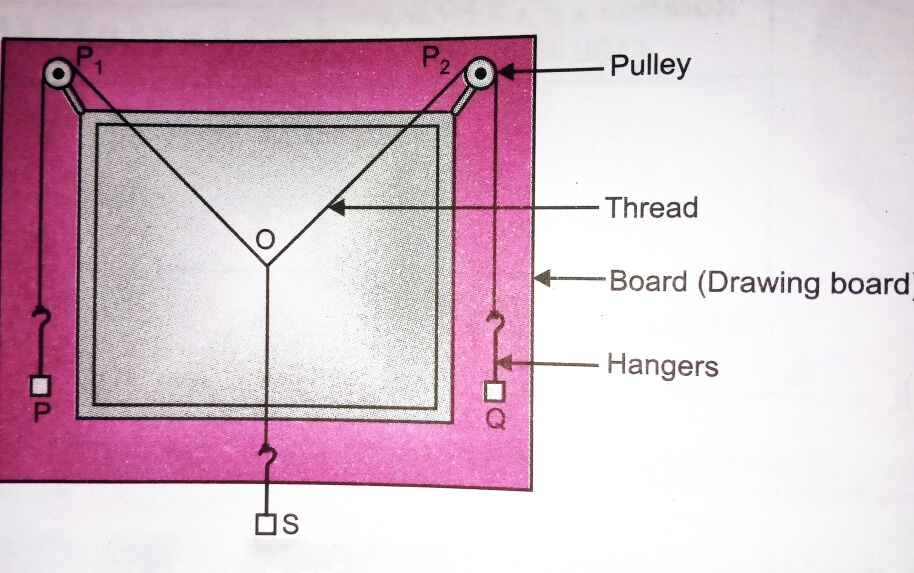
- Gravesand’s apparatus (vertical wooden board with two pulleys)
- Three hangers
- A given body (unknown mass)
- Thin but strong string
- White paper sheets
- Mirror strip
- Thumb pins
- Protractor
- Half-metre scale
- Spring balance
Theory
According to the parallelogram law of vector addition, if two vectors are represented in magnitude and direction by the adjacent sides of a parallelogram, the resultant is represented by the diagonal.
If P and Q are the magnitudes of two vectors and θ is the angle between them, then:
[ R^{2} = P^{2} + Q^{2} + 2PQ\cos\theta ]
Here, R (or S) is the resultant vector.
Procedure
- Place the Gravesand’s apparatus vertically and ensure the pulleys move smoothly.
- Fix a white paper sheet on the board using thumb pins.
- Place a string over the pulleys and attach hanger weights on both ends.
- Tie another string at the midpoint of the first string and suspend the unknown weight from it.
- Adjust slotted weights on the hangers until the knot comes to the centre of the sheet.
- Place a mirror strip under each string and mark its direction using image-coincidence.
- Remove the sheet and join the marked points to meet at O.
- Choose a suitable scale (e.g., 1 unit = 50 g wt).
- Draw OA and OB proportional to forces P and Q.
- Complete the parallelogram OACB and draw diagonal OC.
- Measure OC and convert it using the chosen scale to get the weight of the unknown body.
- Verify using a spring balance.
- Repeat the experiment with different weights.
Observations
(Add your images here)
Precautions
- Ensure pulleys are frictionless.
- The board must be perfectly vertical.
- Hangers should not touch the board.
- The knot (point O) must lie at the centre of the sheet.
- Mark all points with a sharp pencil.
Sources of Error
- Board not perfectly vertical.
- Pulleys not frictionless.
- Errors while marking points.