Determine Resistance Per Unit Length of a Wire – Class 12 Physics Practical
- June 9, 2019
Aim
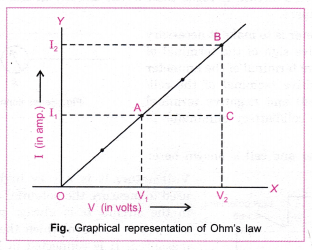
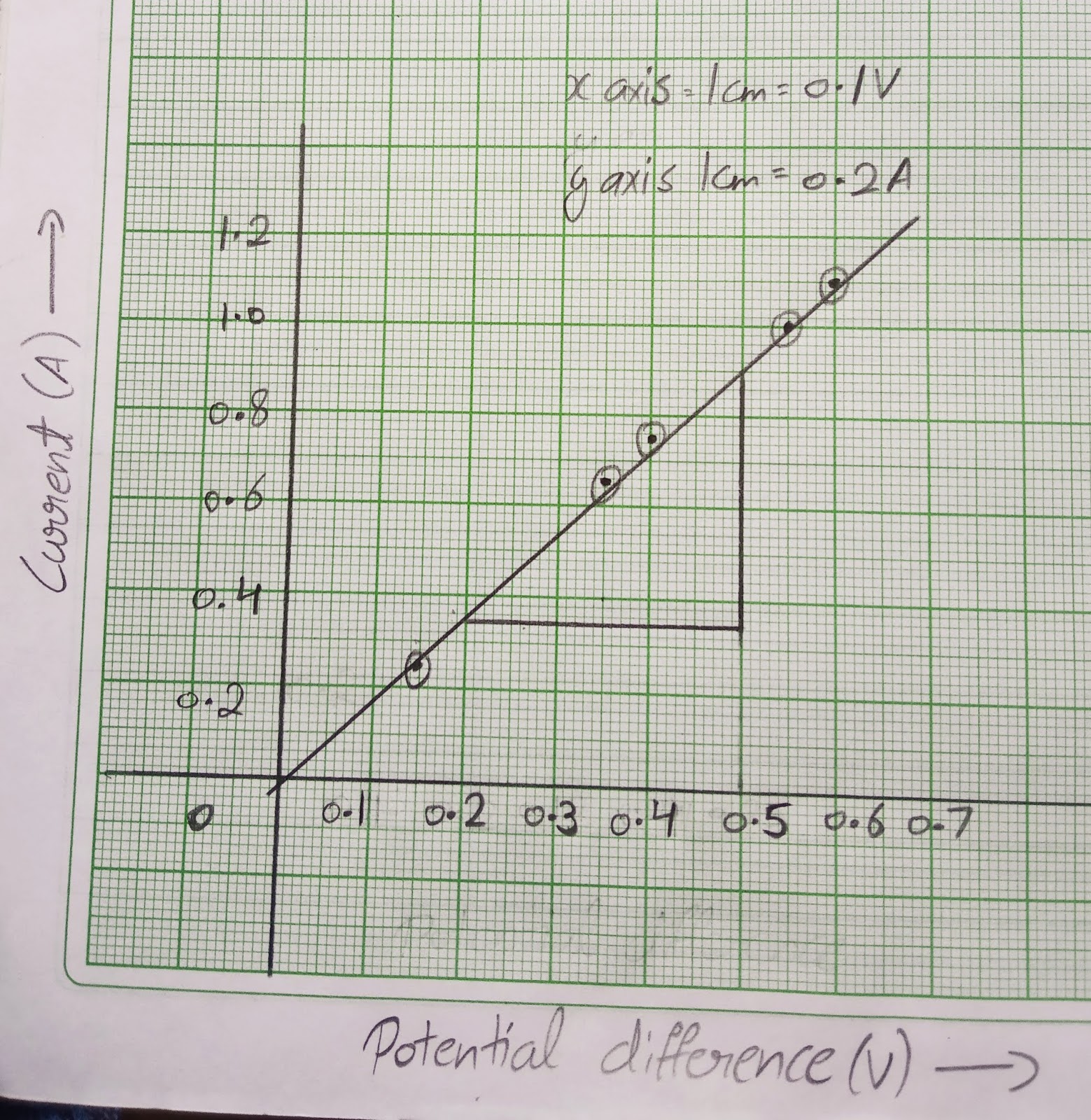
To determine the resistance per unit length of a given wire by plotting a graph of potential difference versus current.
Material Required
A wire of unknown resistance, battery, voltmeter (0–5 V), ammeter (0–1.5 A), rheostat, plug key, connecting wires, and sandpaper.
Principle
According to Ohm’s Law, the current flowing through a conductor is directly proportional to the potential difference across it, provided temperature and physical state remain constant.
If:
- I = current
- V = potential difference
then:
V ∝ I
V = RI
where R is the electrical resistance.
Resistance of a wire of:
- length l
- area of cross-section A
is given by:
R = ρ l / A
where ρ is the resistivity of the material.
📷 Ohm’s Law Graph
Procedure
- Clean the ends of the connecting wires with sandpaper to remove insulation.
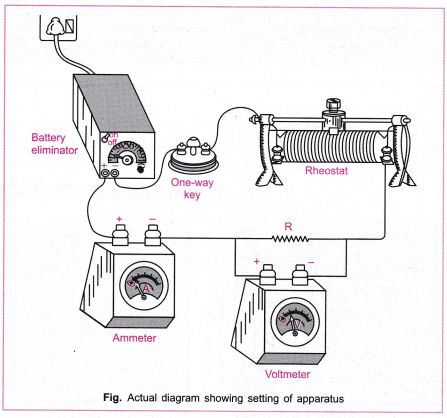
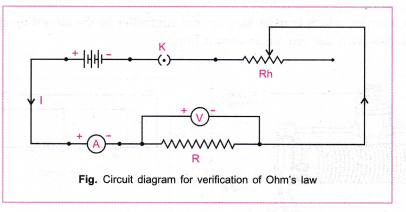
- Connect the resistance wire, rheostat, battery, key, voltmeter, and ammeter as shown in the figure.
📷 Circuit Diagram
- Ensure the pointers in the meters read zero; adjust if required.
- Note the range and least count of the voltmeter and ammeter.
- Insert key K and keep rheostat at the extreme position to allow minimum current.
- Record ammeter and voltmeter readings.
- Remove the key, let the wire cool, then reinsert the key. Adjust rheostat slightly to increase voltage and take readings.
- Repeat step 7 for at least four different values of current.
Observations
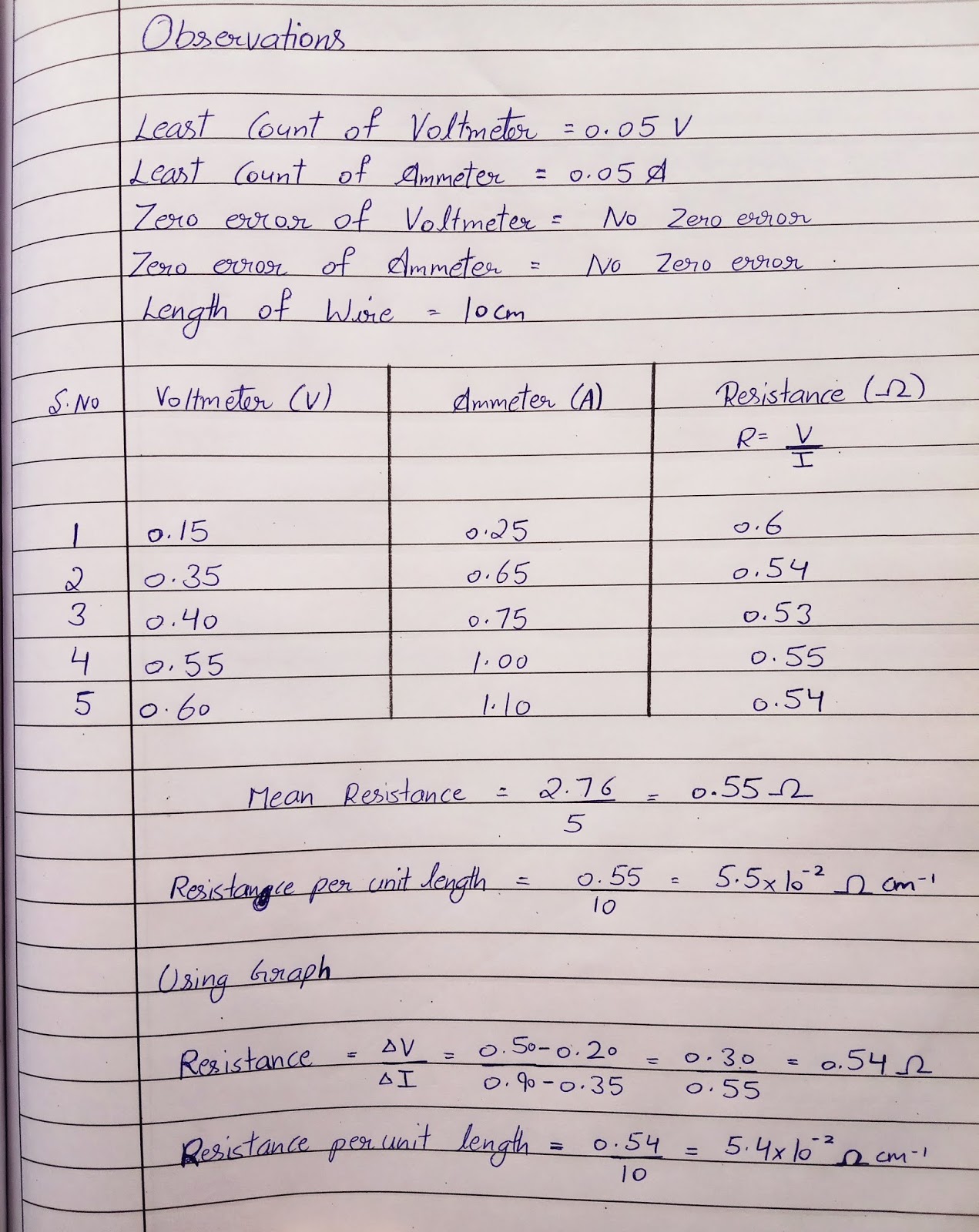
📷 Observation Table (Sample Image)
Result
Resistance per unit length of the given wire is:
- 0.055 Ω/cm (calculated)
- 0.054 Ω/cm (from graph)
Precautions
- Connect the voltmeter in parallel and the ammeter in series.
- Insert the key only while taking readings to avoid heating the wire.
- Correct for zero error in all instruments.
- Ensure tight connections.
- The wire must be uniform and free from kinks.
Sources of Error
- Rheostat may have high internal resistance.
- Thick connecting wires may not be available.
- Loose connections.
- Wire resistance may be too low.