Determine Internal Resistance of a Cell Using a Potentiometer
- July 3, 2019
Aim
To determine the internal resistance of a given primary cell using a potentiometer.
Apparatus Required
Potentiometer, the given primary cell, an ammeter, a battery, resistance box, two one-way keys, galvanometer, rheostat, jockey, and connecting wires.
Theory
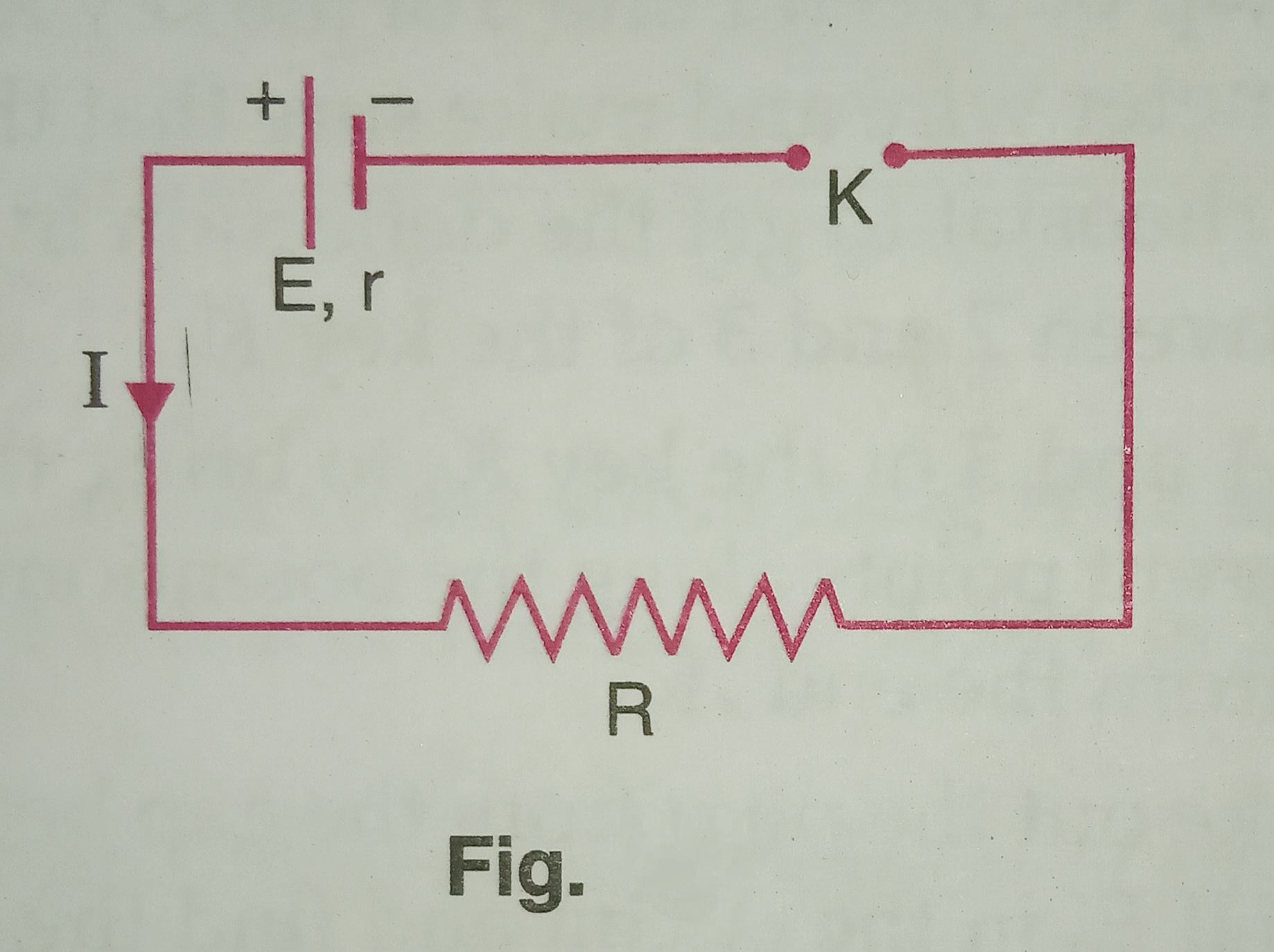
In the circuit, a cell of emf E and internal resistance r supplies current I when the key is closed:
[ E = I(R + r) ]
So,
[ E = IR + Ir = V + Ir ]
Where V is the potential difference across resistance R.
Thus,
[ r = \frac{E - V}{I} = \left(\frac{E}{V} - 1\right) R ]
If
- l₁ = balancing length for emf E
- l₂ = balancing length for potential difference V
Then:
[ r = \left(\frac{l_1}{l_2} - 1\right) R ]
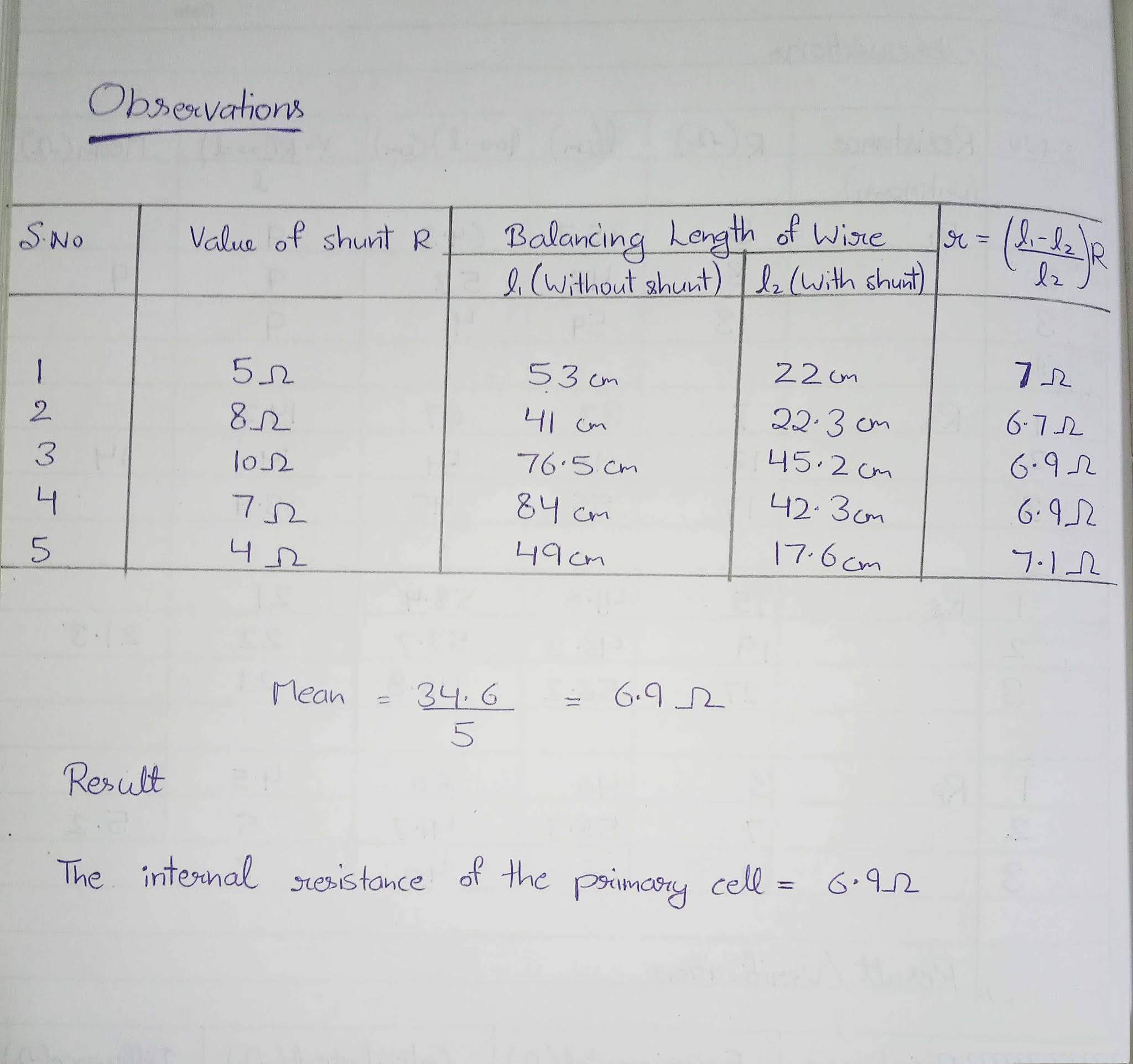
[ r = \frac{(l_1 - l_2)R}{l_2} ]
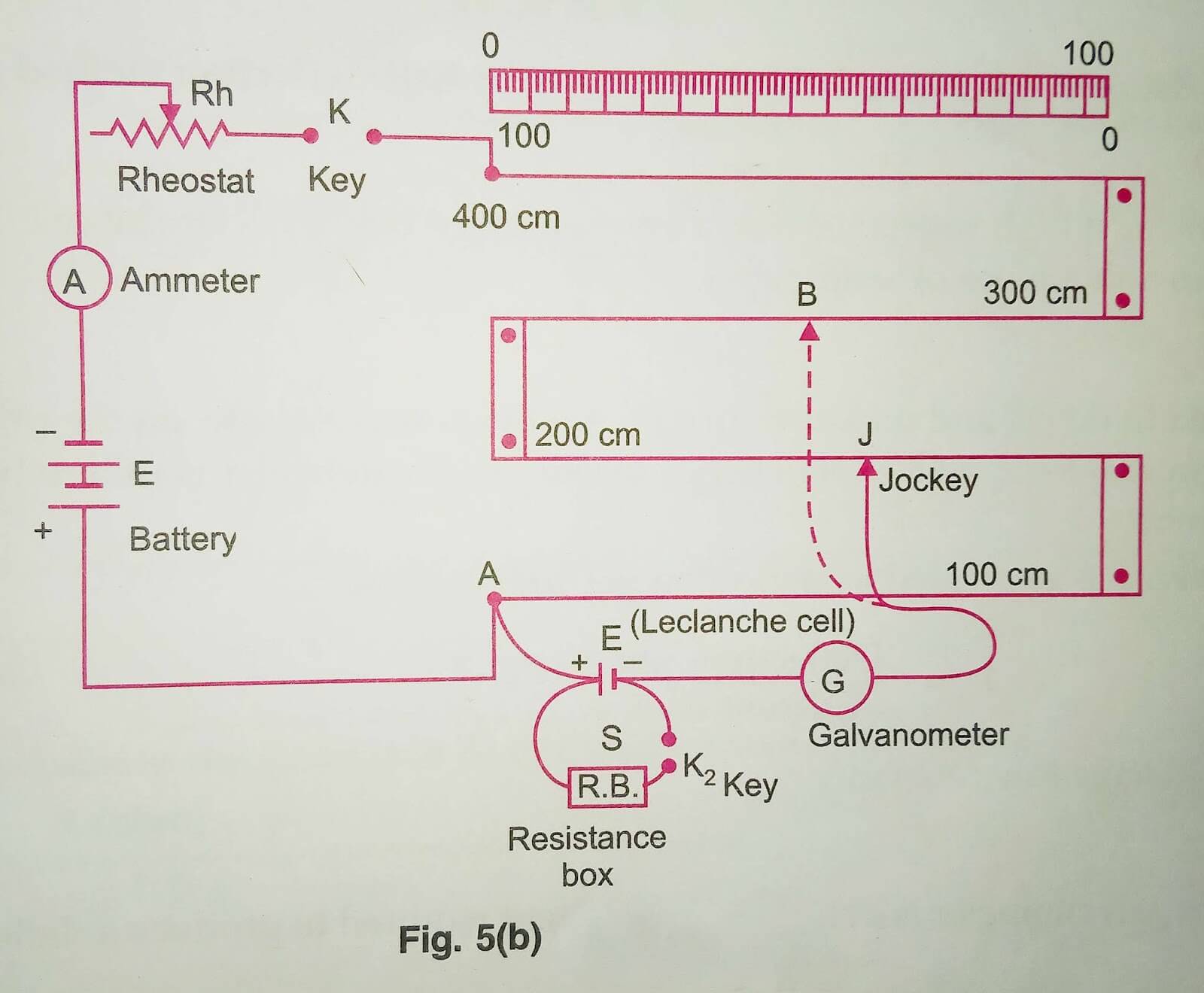
Circuit Diagram
Procedure
- Clean the ends of the connecting wires using sandpaper.
- Set up the circuit as shown in the figure with keys K₁ and K₂ open.
- Close K₁. Touch the jockey near ends A and B of the potentiometer wire—ensure opposite galvanometer deflections. Adjust the rheostat if needed.
- Move the jockey along the wire to find the balancing point and note balancing length l₁.
- Close K₂, introduce resistance R using the resistance box, and repeat the steps to get balancing length l₂.
- Repeat the experiment for at least five different values of R.
Observation Table Image
Precautions
- Clean wire ends with sandpaper before making connections.
- Ensure all connections are tight.
- Connect positive terminals of the battery and primary cell to the same end of the potentiometer wire.
- The emf of the battery must be greater than that of the primary cell.
- Do not slide the jockey—touch gently and momentarily.
- Use current for the shortest time to prevent heating.
Sources of Error
- Loose connections.
- The emf of the battery may be less than that of the primary cell.
- Keys may remain inserted for too long, heating the potentiometer wire.