Determine the Resistance of a Galvanometer by Half-Deflection Method
- July 12, 2019
Aim
To determine the resistance of a galvanometer by the half-deflection method and to find its figure of merit.
Apparatus
A moving-coil galvanometer, battery or battery eliminator (0–6 V), high-resistance box, small resistance box, two one-way keys, voltmeter, connecting wires, and sandpaper.
Theory
Circuit Diagram
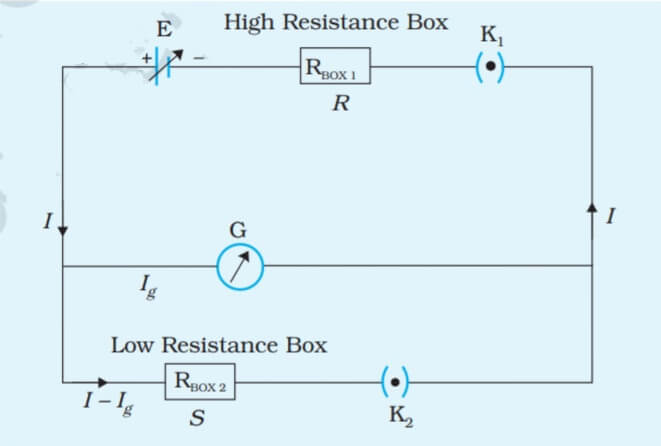
Procedure
- Clean all connecting wires using sandpaper and make tight connections as per the circuit diagram.
- From the high resistance box, remove a plug and close key K1.
Adjust resistance R to obtain full-scale deflection on the galvanometer.
Record values of R and deflection θ. - Insert key K2 and keep R fixed.
Adjust shunt resistance S to obtain a deflection exactly half of θ.
Note the value of S, then remove plug K2. - Repeat steps 2 and 3 for five sets of observations such that θ is even (for easier halving).
Record R, S, θ, and 2θ in a table. - Calculate:
- Galvanometer resistance ( G )
- Figure of merit ( k )
Observations & Calculations
Precautions
- Insert key K1 only after taking out a high value of R from the resistance box; otherwise the galvanometer coil may burn.
- Choose R so that the galvanometer shows an even deflection, making θ/2 easier to obtain.
- Ensure the EMF of the battery remains constant.
- Use the highest possible value of R for better accuracy of G.
- Ensure all plugs and connections are tight.
Sources of Error
- Plugs in the resistance boxes may be loose or unclean.
- The EMF of the battery may fluctuate during the experiment.