Find the Frequency of AC Mains Using a Sonometer – Class 12 Physics Practical
- December 22, 2019
Aim
To find the frequency of the AC mains using a sonometer.
Apparatus Required
Sonometer with non-magnetic wire, horse-shoe magnet, step-down transformer (220–6 V), screw gauge, weights, and a hanger.
Theory
A current-carrying conductor inside a magnetic field experiences a force.
When AC flows through the wire, the force reverses every half cycle, causing the wire to oscillate at the same frequency as the AC mains.
For a wire of:
- length l
- mass per unit length m
- tension T
the frequency v is given by:
v = (1 / 2l) × √(T / m)
Procedure
- Set up the apparatus as shown in the figure below.
📷 Experimental Setup
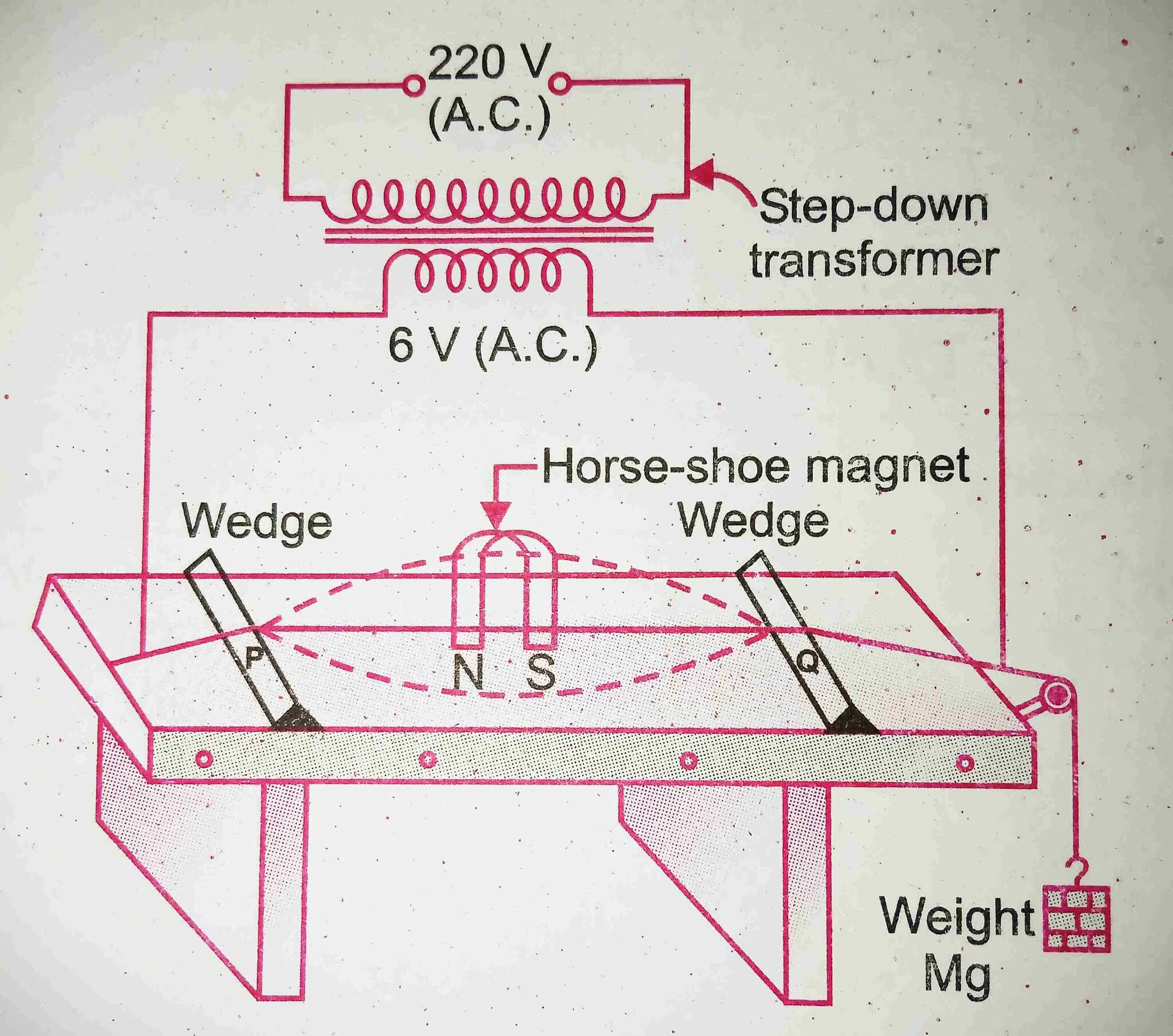
Setup for finding frequency of AC mains using a sonometer
Place the horse-shoe magnet between the wooden wedges.
(If using an electromagnet, adjust its pole close to the center of the wire.)Suspend a weight (e.g., 1 kg) from the hanger and switch on the AC supply.
Adjust wedges A and B until the wire vibrates with maximum amplitude (resonance).
Test resonance using a paper rider—it should fly off when resonance is achieved.Measure the resonating length PQ when distance between wedges is increased.
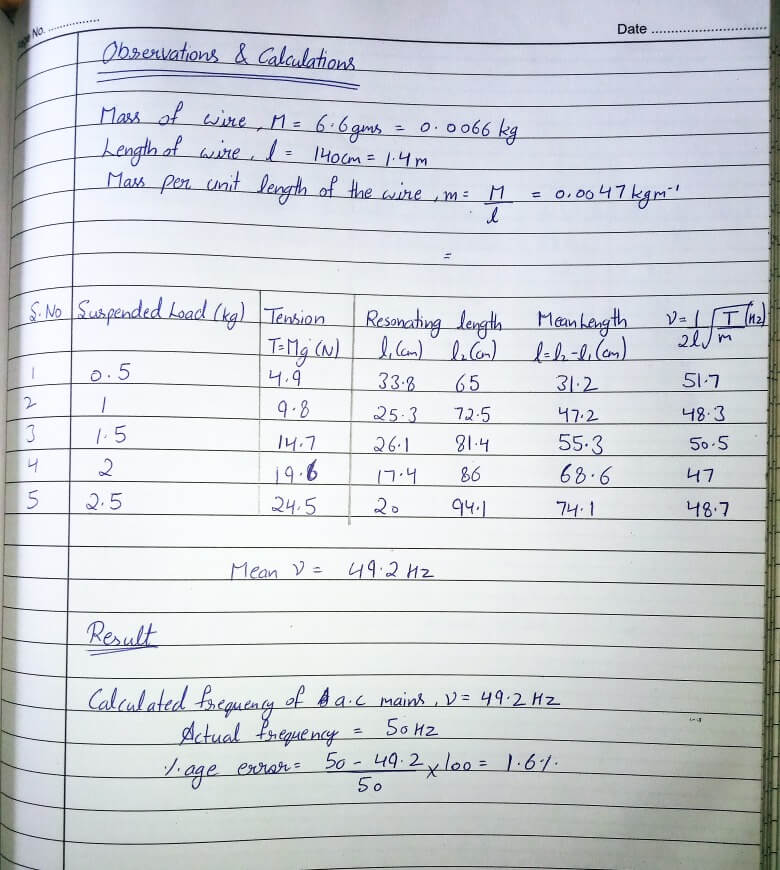
Repeat when the distance is decreased.Increase the load by 0.5 kg each time and repeat steps 4 & 5 to record at least five readings.
Take ~1 m length of wire and find its mass using a physical balance.
Observation & Calculations
Precautions
- The wire must be uniformly thick with no kinks.
- Horse-shoe magnet should be exactly in the middle of the wedges.
- Tension should not exceed elastic limit.
- Weight of the hanger must be counted.
- Sonometer wire must be non-magnetic.
- Magnet should not touch the wire.
- Wedges must have sharp edges.
Sources of Error
- Wire is not of uniform cross-section or has kinks.
- Friction at the pulley causes actual tension to differ from applied tension.