Finding the Focal Length of a Convex Mirror Using a Convex Lens
- December 24, 2019
Aim
To find the focal length of a convex mirror using a convex lens.
Apparatus Required
An optical bench, four uprights (at least two with lateral movement), a convex mirror, a convex lens, a lens holder, two needles, and a half metre scale.
Theory
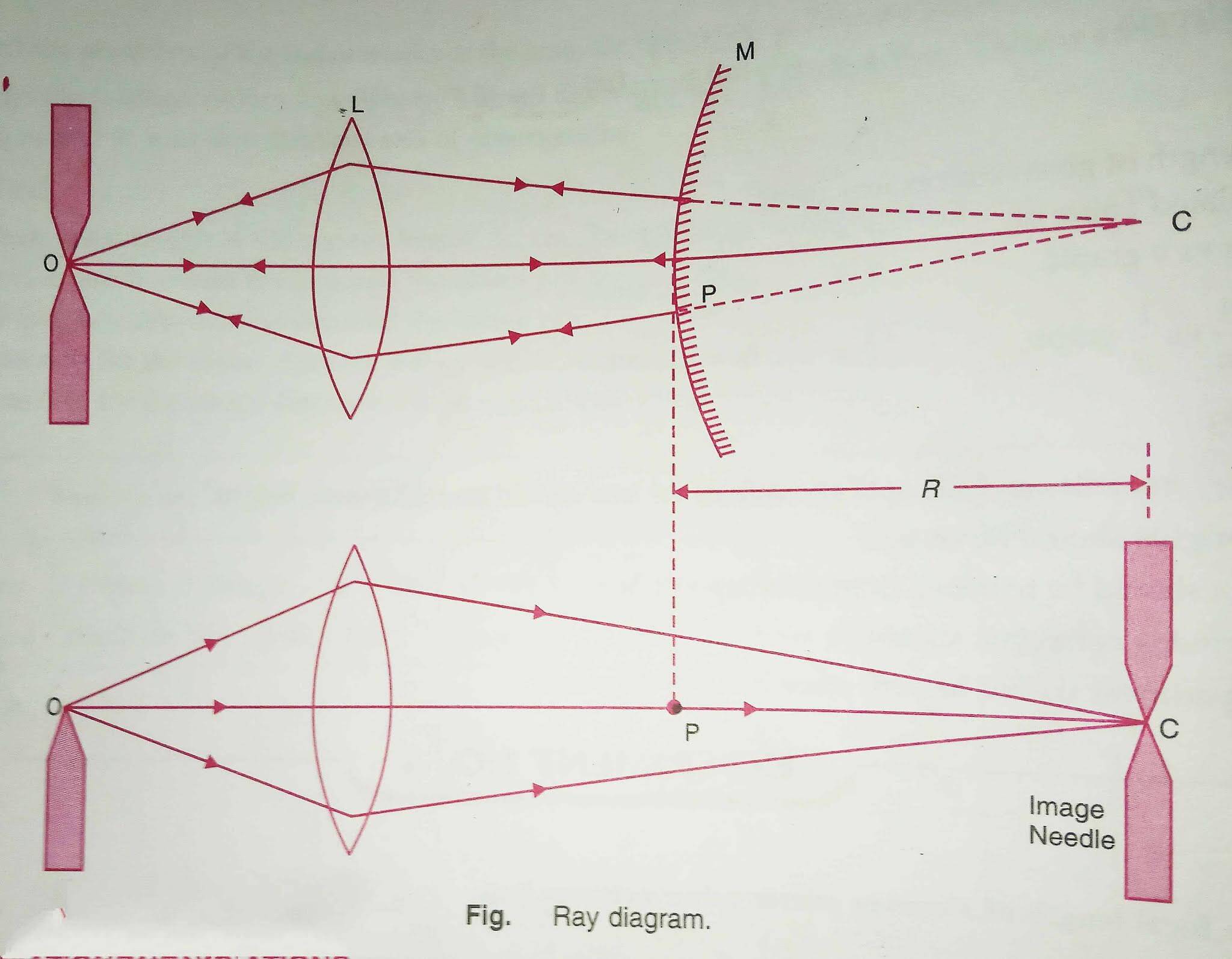
A convex lens produces a real image of an object ‘O’ located at ‘C’. A convex mirror is placed in the path of the rays between the lens and the image such that the rays after refraction through the lens fall normally on the surface of the mirror. The rays are then reflected back retracing their path and produce an image on the object.
Thus:
[
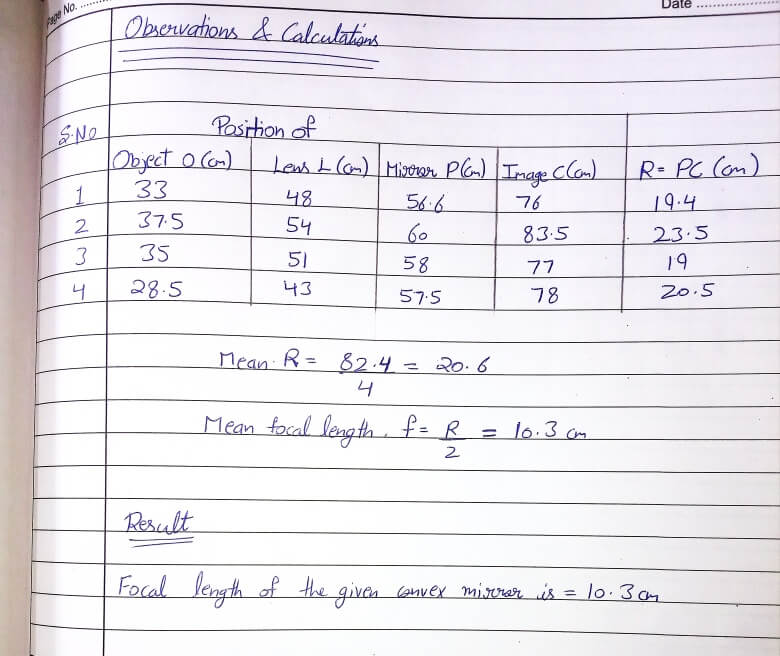
PC = R
]
and
[
f = \frac{R}{2} = \frac{PC}{2}
]
Ray Diagram
Procedure
- Find the approximate focal length of the given convex lens by focusing the image of a distant object (say, a tree) on a screen and recording the separation between the lens and the image.
- Mount the object needle, the lens and the mirror on the optical bench as shown. Adjust height so that the tip of the object needle, the optical centre of the lens and the pole of the mirror lie on the same horizontal level.
- Keep the object pin between F and 2F of the lens. Adjust the needle and the mirror such that there is no parallax between the tip of the object needle and its inverted image formed at O itself.
- Note the positions of the object (O), the lens (L) and the mirror (M).
- Remove the mirror and keep another needle C on the same side as the mirror. Adjust the needle C so as to remove the parallax between the image of O and the needle C. Record this position of C.
- Repeat the steps above 3-5 to record at least five different positions of the object and the lens.
- Find the index correction between the mirror and image needle as explained earlier.
Observations & Calculations
Precautions
- The tips of the needles and the centres of the lens and the mirror should be at the same height.
- Parallax should be removed tip-to-tip.
- The distance between the lens and the mirror should be small.
- While adjusting the image needle, the lens and the object needle should not be disturbed.
- The index correction should be carefully recorded and applied.
Sources of Error
- Parallax not removed completely.
- The uprights are not perfectly vertical.
- The optical centre, pole of the mirror and the tip of the object needle are not placed on a straight line.