Comparing the EMF of Two Primary Cells Using a Potentiometer
- July 3, 2019
Aim
To compare the EMF of two given primary cells (Daniel and Leclanche cells) using a potentiometer.
Apparatus Required
Potentiometer, galvanometer, rheostat, one-way key, two-way key, jockey, connecting wires, Leclanche cell, Daniel cell, ammeter, secondary cell, and sandpaper.
Theory
A potentiometer is an instrument used to measure small potential differences accurately and to compare the EMFs of two cells.
It works on the principle:
For a wire of uniform cross-section carrying steady current,
the potential difference across it is directly proportional to its length.
If two cells of EMF (E_1) and (E_2) are balanced at lengths (l_1) and (l_2) respectively, then:
[ \frac{E_1}{E_2} = \frac{l_1}{l_2} ]
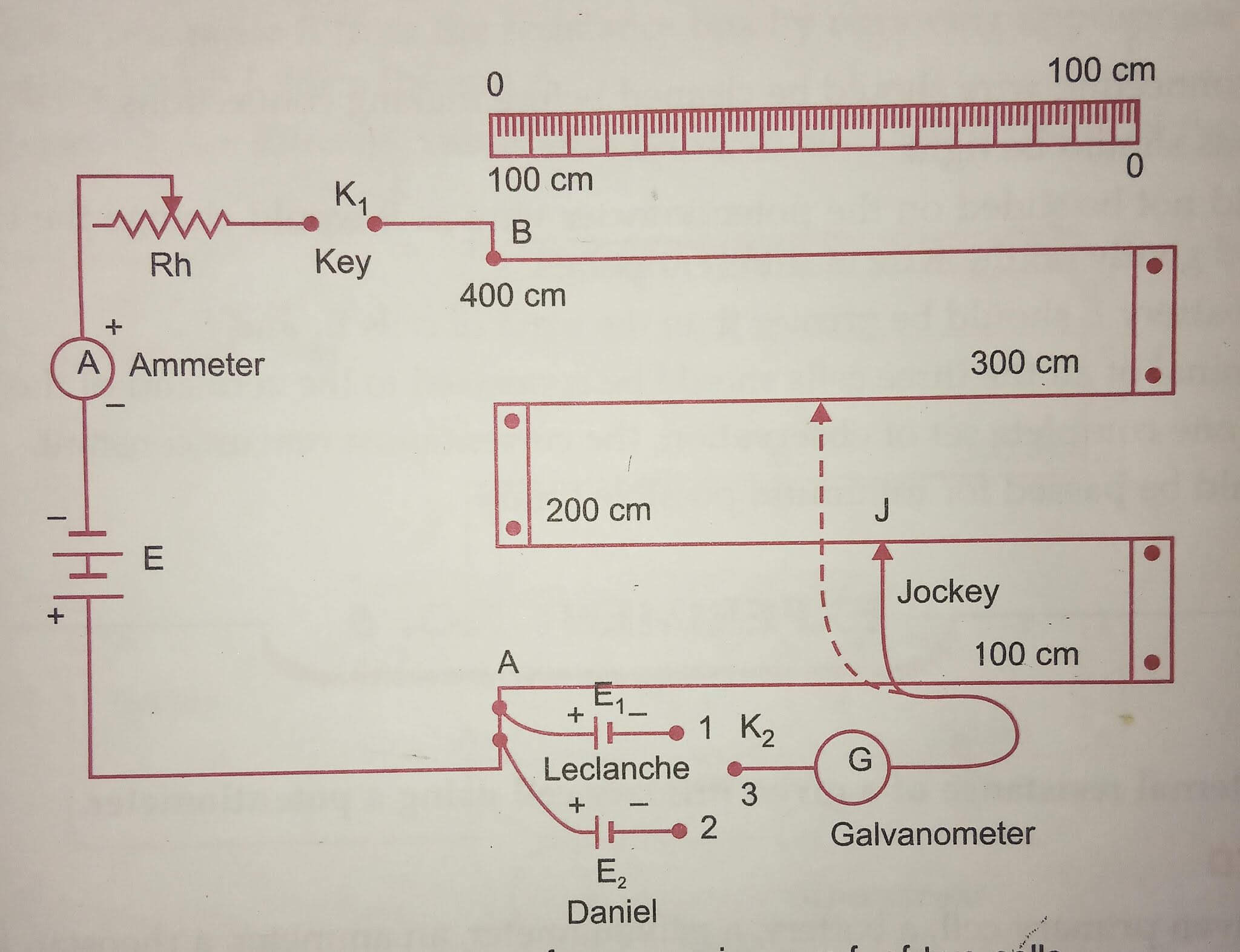
Circuit Diagram
Procedure
- Clean the ends of the connecting wires and make the connections as shown in the circuit diagram.
- Keep keys (K_1) and (K_2) open. Use the Leclanche cell as (E_1) and the Daniel cell as (E_2).
- Close key (K_1). Insert the plug between points 1 and 3 of key (K_2).
Place the jockey near end A and then end B of the potentiometer wire.
Ensure the galvanometer shows deflections in opposite directions.
If not, adjust the rheostat. - Insert the plug between 1 and 3 of (K_2) to bring cell (E_1) into the circuit.
Find the balancing point by placing the jockey at various points on the wire.
Do not slide the jockey.
Record balancing length (l_1) from end A. - Without changing the rheostat setting, switch the plug to between 2 and 3 of (K_2) to bring cell (E_2) into the circuit.
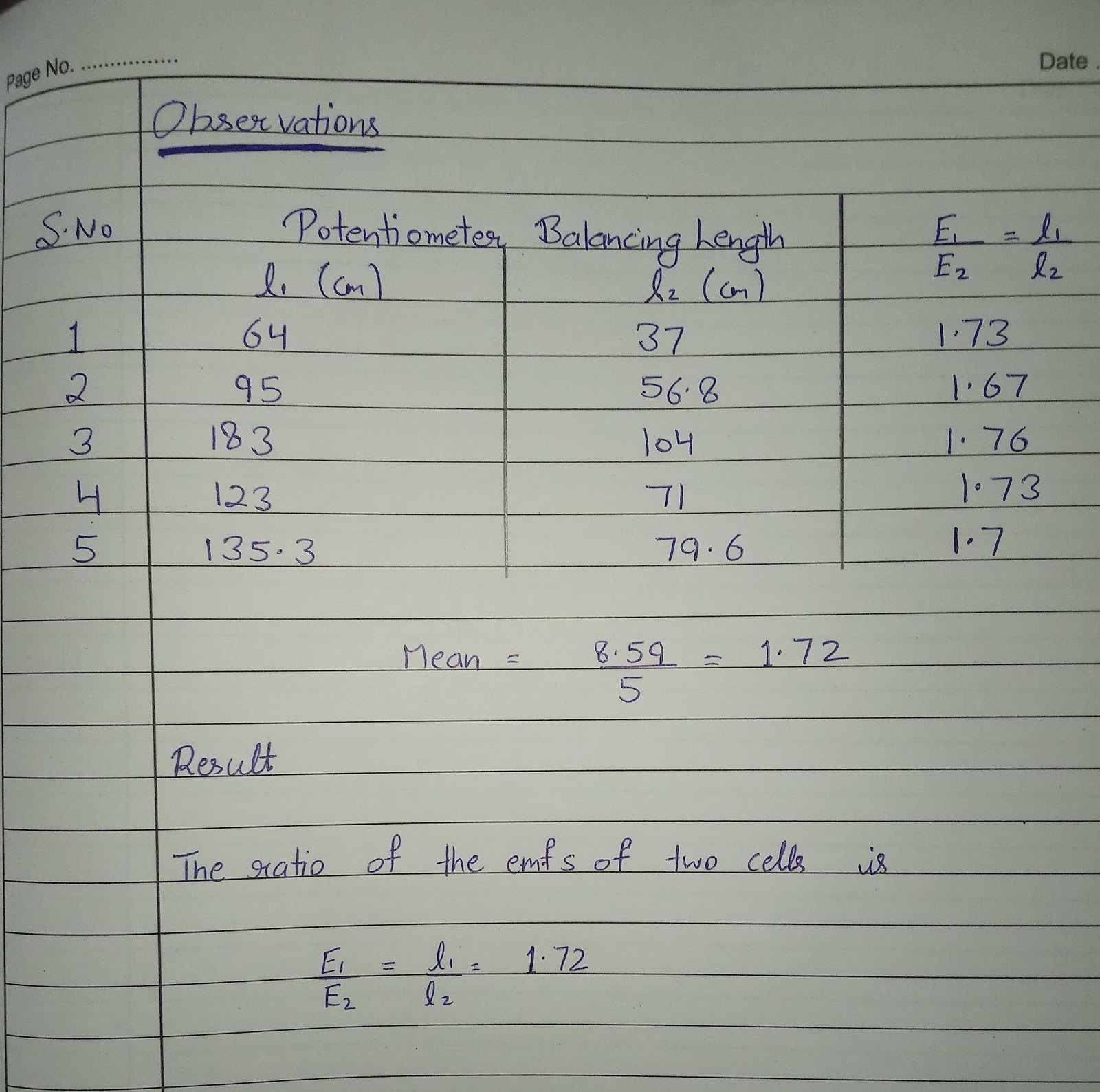
Find and record balancing length (l_2). - Repeat steps 4 and 5 for different positions of the rheostat slider to obtain multiple readings.
Observations
Precautions
- Clean the ends of connecting wires before making connections.
- All connections must be tight.
- Never slide the jockey along the potentiometer wire. Press gently at points.
- EMF of the battery (E) must be greater than EMFs of (E_1) and (E_2).
- Positive terminals of all cells must connect to the zero end of the potentiometer wire.
- Current must remain constant during one full set of observations.
- Current should be passed for the minimum possible time.
Sources of Error
- Connections may not be tight.
- Keys may be left inserted for long durations, heating the wire.