Measuring the volume of a Calorimeter Using Vernier Calipers
- December 28, 2019
🎯 Aim
To measure the internal diameter and depth of the given beaker/calorimeter and determine its volume.
🧰 Apparatus Required
- Vernier calipers
- Calorimeter
- Magnifying glass
📘 Theory
Vernier Calliper Reading
Total reading in a vernier calliper = [N + (n x V.C.)] cm
Where:
- N = Main scale reading
- n = Vernier scale division that coincides
- V.C. = Vernier constant
Volume of calorimeter
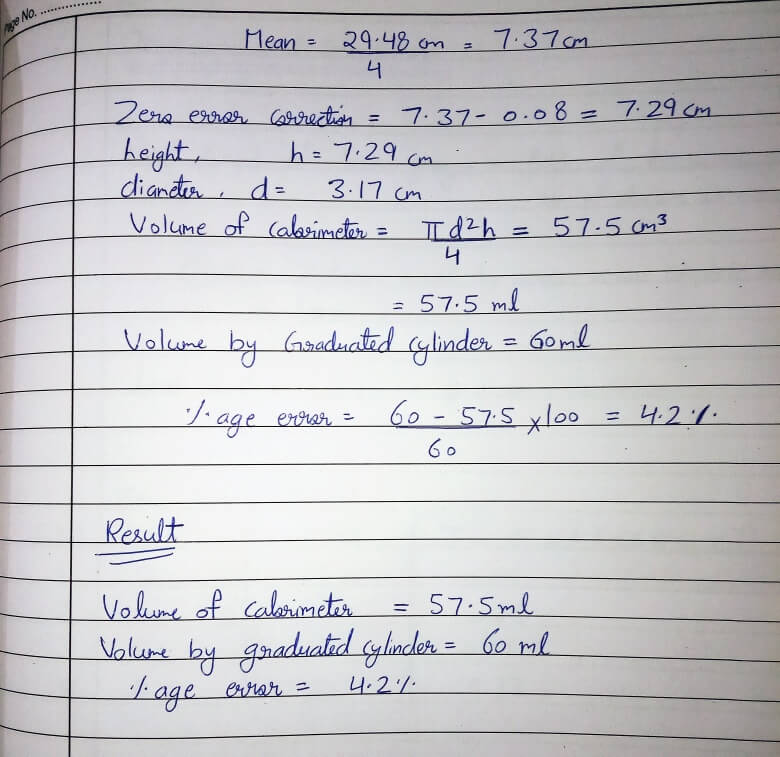
V = (πd²h)/4 = ………. cm³
Here d is the diameter and h is the depth of the calorimeter.
🧭 Procedure
✔️ Preliminary Steps
- Read the main scale and note the value of 1 Main Scale Division (MSD).
- Calculate the Vernier constant using:
V.C. = 1 M.S.D. - 1 V.S.D.(Vernier Scale Division) - Find and record the zero error (positive/negative).
📏 A. Measurement of Internal Diameter
- Insert the upper jaws of the vernier calipers into the calorimeter.
- Gently adjust until the jaws touch the inner wall.
- Note the main scale reading N and the vernier scale reading n.
- Rotate the calorimeter by 90° and repeat to complete one set.
- Take at least two more sets at different positions.
- Apply zero correction to each reading.
📏 B. Measurement of Depth
- Place the right edge of the main scale on the upper rim of the calorimeter.
- Slide the depth rod (strip E) down until it touches the bottom.
- Clamp the screw and note the readings.
- Repeat three times at different positions.
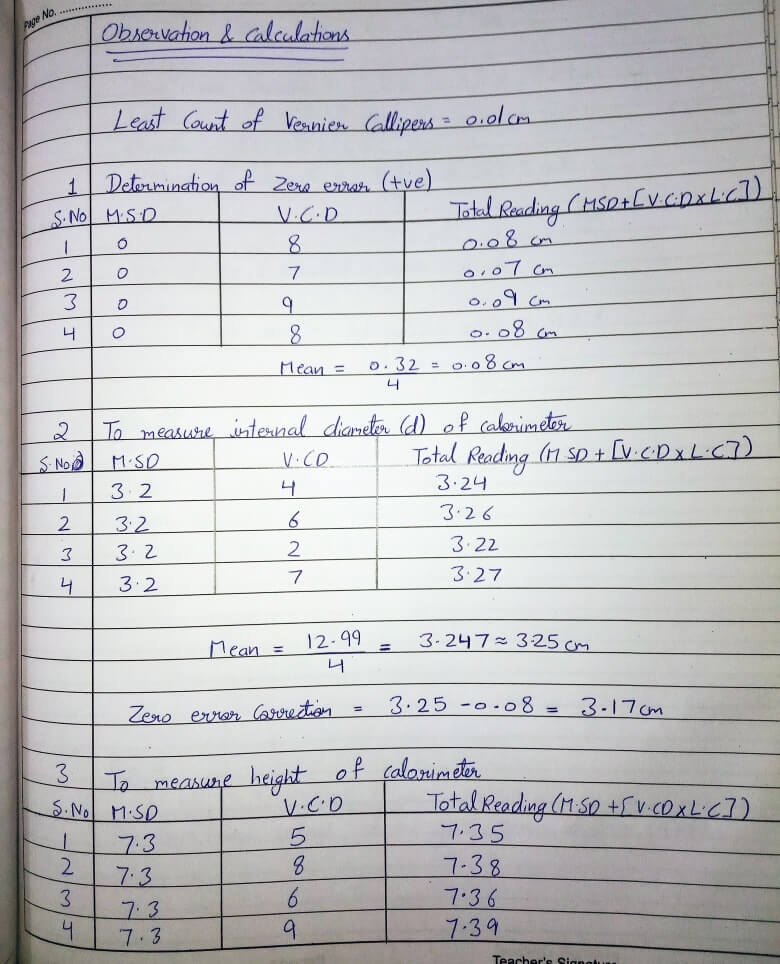
📊 Observations
✔️ Precautions
- Ensure the vernier calipers move smoothly; clean and oil if necessary.
- Grip the object firmly between the jaws.
- Carefully compute Vernier constant and zero error.
- Take readings at right angles for accuracy.
- Use a magnifying glass to identify coinciding vernier divisions.
⚠️ Sources of Error
- Parallax error may lead to incorrect readings.
- The jaws may not be perfectly perpendicular to the object.